Your electricity bill just went up again. You’re wondering if it’s finally time to replace that old aircon with something more energy-efficient.
But then you’re standing in the shop staring at a label covered in stars and numbers, and you have no idea what any of it actually means.
This guide breaks it down clearly: what the star ratings mean, how much money each star actually saves you, which brands are worth looking at, and why even the best 5-star unit starts losing efficiency if it isn’t serviced regularly.
What Is the Energy Star Rating in Malaysia?
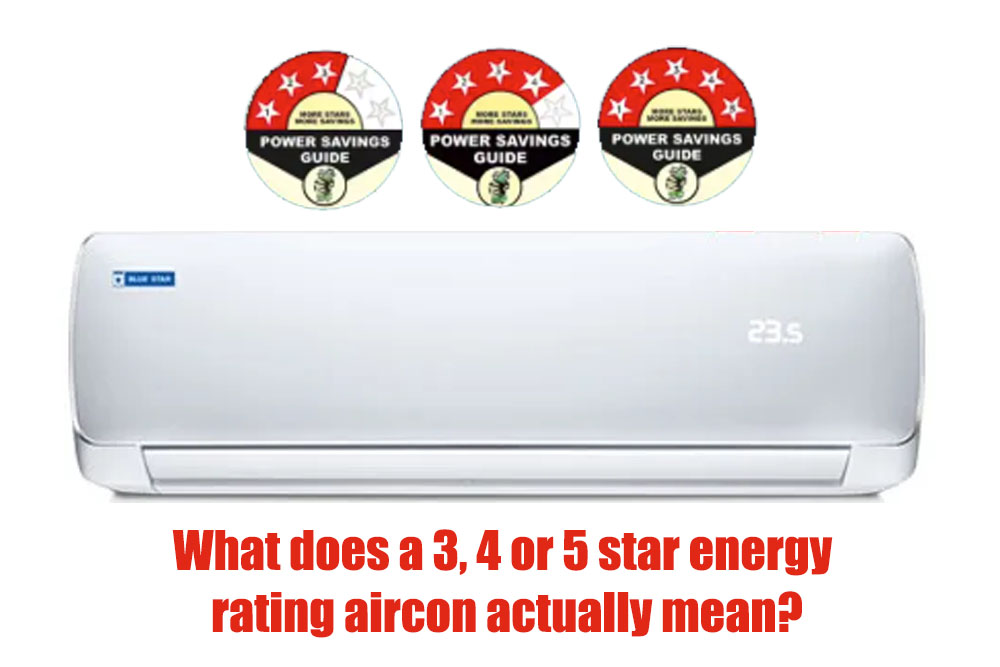
Every residential air conditioner sold in Malaysia must carry an Energy Efficiency Label issued by the Suruhanjaya Tenaga (ST), Malaysia’s Energy Commission. This is the yellow label with stars you see on the unit or its box.
The label is mandatory. All manufacturers and importers must affix the Energy Efficiency Label onto air conditioners before they can be sold to the customer, under the Electricity Regulations 1994 (Amendment 2013).
The rating runs from 1 star (least efficient) to 5 stars (most efficient). The more stars an air conditioner receives, the more energy-efficient it is considered to be. A 5-star air conditioner represents one of the highest levels of energy efficiency available for residential cooling systems in Malaysia.
From 1 January 2026, there is a new star rating schedule for air conditioners set by Suruhanjaya Tenaga, which means the bar for achieving each star level has been raised. If you bought a 5-star unit before 2026, a new model with the same star rating may actually be more efficient than your old one.
What Does the Rating Actually Measure?
The label is based on a metric called CSPF (Cooling Seasonal Performance Factor), which measures how much cooling your aircon delivers per unit of electricity across a full season of real-world use. CSPF measures efficiency averaged across the full cooling load including part-load operation, making it more accurate for inverter aircons because it captures the savings from the compressor throttling down once the room is cool.
Simply put: the higher the CSPF, the more cooling you get per ringgit spent on electricity.
3 Star vs 4 Star vs 5 Star, The Real Electricity Cost Difference in RM
Here’s where it gets practical. How much does a 3 star energy rating air conditioner cost to run compared to a 4 star energy rating air conditioner or a 5 star energy rating air conditioner Malaysia homes are now increasingly choosing? How much does each star actually save you every month?
Let’s use a realistic Malaysian household scenario:
- Unit size: 1.5HP split aircon
- Usage: 8 hours per day
- TNB rate: ~RM 0.445/kWh (domestic tariff effective July 2025, usage under 1,500 kWh/month)
| 3-Star Aircon | 4-Star Aircon | 5-Star Aircon | |
| Compressor type | Non-inverter | Inverter | Inverter |
| Approx. power draw | ~1,400W | ~1,050W | ~850W |
| Daily usage (8 hrs) | 11.2 kWh | 8.4 kWh | 6.8 kWh |
| Monthly electricity (30 days) | 336 kWh | 252 kWh | 204 kWh |
| Monthly TNB cost (est.) | ~RM 149 | ~RM 112 | ~RM 91 |
| Monthly savings vs 3-star | , | ~RM 37 | ~RM 58 |
| Annual savings vs 3-star | , | ~RM 444 | ~RM 696 |
Note: These are estimated figures based on typical 1.5HP unit power consumption and the TNB domestic tariff from July 2025. Actual figures vary by brand, room size, usage habits, and ambient temperature.
The numbers tell a clear story. Choosing a 5-star inverter over a 3-star non-inverter can save you roughly RM 58 per month, or close to RM 700 per year, on a single unit. With two or three units running in a house, those savings multiply fast.
Air conditioning accounts for 40–60% of a home’s monthly TNB bill, especially in hot climates like Malaysia. This makes choosing an energy-efficient aircond one of the smartest decisions a Malaysian homeowner can make.
Inverter vs Non-Inverter, Which Saves More?
Short answer: inverter wins, every time, but here’s why.
A non-inverter aircon works like an on/off switch. The compressor runs at full power until the room hits the target temperature, then cuts off completely. When it gets warm again, it switches back to full power. This cycle repeats all night, and each full-power startup draws a spike of electricity.
An inverter aircon works more like a car accelerator. The compressor ramps up quickly to cool the room, then slows down, not off, just slower, to maintain the temperature. No constant on/off cycling. No power spikes. Inverter compressors dominate the 4-star and 5-star categories, while 2-star and 3-star units are overwhelmingly non-inverter.
The Real-World Advantage of Inverter
- Lower electricity bills, runs at reduced power most of the time
- Faster cooling, ramps up to full speed at startup, then settles
- Quieter, no abrupt on/off cycling means less noise and vibration
- Longer lifespan, less mechanical stress on the compressor
- Better temperature consistency, room stays at your set temperature rather than fluctuating
The trade-off is upfront cost. An inverter unit typically costs RM 300–600 more than a comparable non-inverter model. But as the electricity cost table above shows, the savings pay back the difference within a year or two for most Malaysian households.
Best Energy-Saving Aircon Brands in Malaysia
If you’re comparing energy-efficient aircon prices in KL and Selangor, or trying to find the best energy saving air conditioner Malaysia has available, these are the brands worth looking at. When people ask which is the best inverter air conditioner Malaysia homeowners should buy, or which jenama aircond paling jimat elektrik, these names come up consistently. All have strong track records on inverter technology and energy efficiency:
Daikin
Often considered the benchmark for reliability in Malaysia. Daikin’s inverter range (FTKU and FTKF series) consistently hits 4–5 star ratings and is known for very quiet operation. The R32 refrigerant models are also better for the environment. A strong choice for bedrooms and living rooms where you want set-and-forget reliability.
Panasonic
Panasonic’s inverter models (CS-PU and CS-Z series) are popular for their econavi sensor which automatically adjusts cooling output based on room activity, saving electricity when no one is in the room. Good range of wifi-enabled models for smart home control.
Mitsubishi Electric
Premium build quality and exceptionally quiet indoor units. The Mitsubishi Electric MS/MU-JP series is a favourite for bedrooms where noise matters. Generally more expensive but built to last. Their inverter models routinely achieve 5-star ratings.
LG
LG’s Dual Inverter compressor technology is worth noting, it runs on a wider range of frequencies than standard inverter models, which LG claims improves efficiency further and extends compressor life. The LG AP and ArtCool series offer both performance and aesthetics.
Acson (Daikin subsidiary)
Acson’s Reino+ wall-mounted inverter series has achieved the highest 5-star Energy Efficiency Rating from the Energy Commission of Malaysia, offering energy savings of up to 47%. Worth considering if budget is a factor, often priced slightly lower than Daikin while using the same core compressor technology.
Quick Comparison for KL & Selangor Buyers
For those who want to compare energy efficient aircon prices in KL, here’s a quick brand breakdown. Aircond jimat elektrik 5 bintang models are available from all these manufacturers, but prices and features differ:
| Brand | Inverter? | Typical Star Rating | Best For |
| Daikin | Yes | 4–5 star | Reliability, quiet operation |
| Panasonic | Yes | 4–5 star | Smart features, sensors |
| Mitsubishi Electric | Yes | 5 star | Ultra-quiet, bedrooms |
| LG | Yes | 4–5 star | Dual inverter efficiency |
| Acson | Yes | 5 star | Value-for-money 5-star |
Why Your 5-Star Aircon Might Not Be Saving as Much as It Should
Here’s the part nobody tells you when you buy a new aircon.
The star rating reflects how the unit performed when it was tested as a new unit. Real-world efficiency drops over the years as coils get dirty, refrigerant levels fall, and components wear.
In Malaysia’s humid climate, aircon coils and blower wheels attract mould and dust buildup faster than in dryer countries. A dirty coil has to work harder to transfer heat, meaning your compressor runs longer, draws more electricity, and your 5-star unit starts behaving like a 3-star one.
The same applies to refrigerant. A slow gas leak (common in older units) reduces cooling capacity and forces the compressor to compensate with more power.
Regular servicing is not just about hygiene, it’s directly tied to energy efficiency.
Here’s what happens when you skip servicing:
- Dirty air filter, restricts airflow, compressor runs longer → higher electricity bills
- Dirty evaporator coil, reduces heat exchange efficiency → unit works harder for less cooling
- Low refrigerant gas, cooling capacity drops, compressor overcompensates → energy waste and compressor damage
- Clogged drainage, water backup causes the unit to shut down or run inefficiently
A professional chemical wash restores your aircon’s heat exchange efficiency, effectively bringing it closer to its original star-rated performance. Many customers report noticeable electricity bill reductions after a proper chemical wash.
How Often Should You Service Your Energy-Efficient Aircon?
| Service Type | Recommended Frequency | What It Does for Efficiency |
| General cleaning | Every 3–6 months | Removes filter dust, restores airflow |
| Chemical wash | Every 1–2 years | Deep-cleans coil and blower, restores heat exchange |
| Chemical overhaul | Every 2–3 years | Full dismantle clean, maximum efficiency restoration |
| Gas top-up check | When cooling feels weak | Restores refrigerant to correct level |
The Bottom Line
Choosing a 4-star or 5-star inverter aircon in Malaysia is one of the smartest home investments you can make, especially with TNB tariffs increasing from July 2025. The savings over 5–10 years far outweigh the higher upfront price.
But a 5-star rating is not a set-and-forget guarantee. The unit will only perform at that rating if it’s kept clean and properly maintained. Skipping regular servicing is, in effect, paying for a 5-star aircon while getting 3-star performance.
The formula is simple: buy efficient, then keep it efficient.
Keep Your Aircon Running at Peak Efficiency, Book a Service with MY AC COOL
MY AC COOL provides professional aircon servicing across Kuala Lumpur, Selangor, and Negeri Sembilan, general cleaning, chemical wash, and chemical overhaul for all major brands including Daikin, Panasonic, Mitsubishi, LG, and Acson.
Our services start from RM 110. Free transportation. No hidden charges. 30-day warranty on chemical services.
WhatsApp us to book: [018-400 6624] Or book online: [myaccool.com]
Aircond jimat elektrik bermula dengan servis yang betul. / An energy-saving aircon starts with proper servicing.